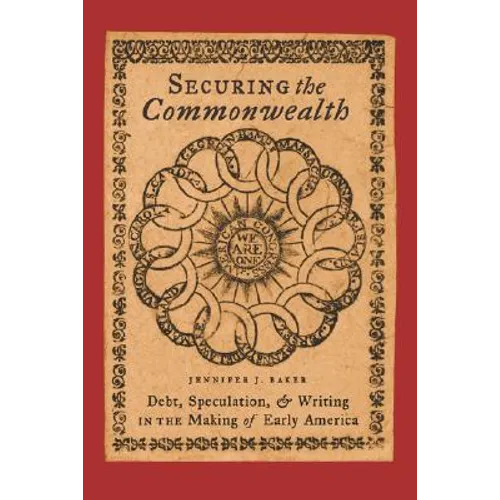
Securing the Commonwealth: Debt, Speculation, and Writing in the Making of Early America - Paperback
Securing the Commonwealth: Debt, Speculation, and Writing in the Making of Early America - Paperback
Shipping: $8.00 or FREE when you spend $100+
Couldn't load pickup availability
by Jennifer J. Baker (Author)
Securing the Commonwealth examines how eighteenth-century American writers understood the highly speculative financial times in which they lived. Spanning a century of cultural and literary life, this study shows how the era's literature commonly depicted an American ethos of risk taking and borrowing as the peculiar product of New World daring and the exigencies of revolution and nation building. Some of the century's most important writers, including Cotton Mather, Benjamin Franklin, Royall Tyler, Charles Brockden Brown, and Judith Sargent Murray, believed that economic and social commonwealth-and one's commitment to that commonwealth-might be grounded in indebtedness and financial insecurity. These writers believed a cash-poor colony or nation could not only advance itself through borrowing but also gain reputability each time it successfully paid off a loan. Equally important, they believed that debt could promote communality: precarious public credit structures could exact popular commitment; intricate financial networks could bind individuals to others and to their government; and indebtedness itself could evoke sympathy for the suffering of others. Close readings of their literary works reveal how these writers imagined that public life might be shaped by economic experience, and how they understood the public life of literature itself. Insecure times strengthened their conviction that writing could be publicly serviceable, persuading readers to invest in their government, in their fellow Americans, and in the idea of America itself.
Front Jacket
Securing the Commonwealth examines how eighteenth-century American writers--including Cotton Mather, Benjamin Franklin, Royall Tyler, Charles Brockden Brown, and Judith Sargent Murray--understood the highly speculative financial times in which they lived. Spanning a century of cultural and literary life, this study shows how the era's literature commonly depicted an American ethos of risk taking and borrowing as the peculiar product of New World daring and the exigencies of revolution and nation building.
An incisive new study . . . Baker conceptualizes her readings in pathbreaking ways.--American Literature
A thought-provoking gem of a book . . . All historians and literary critics with an interest in eighteenth-century economic culture will want to read it.--William and Mary Quarterly
Baker's argument is instructive and well founded.--Journal of American History
Both a primer educating one into the financial thinking of early Anglo-America and a testament to the energy and creativity with which successive generations of provincials imagined commerce as a process of mediation.--Early American Literature
Baker has written an incisive, provocative, sparkling book.--American Antiquarian Society
Historically astute study.--Journal of the Early Republic
Baker brings a fresh and critical eye to works already well-known to specialists but probably unfamiliar to historians in general.--Journal of Interdisciplinary History
Astute and surprisingly lively volume . . . Highly recommended.--Choice
Jennifer J. Baker is an assistant professor of English at New York University.
--Jay Fliegelman, Stanford University "American Historical Review"Back Jacket
Securing the Commonwealth examines how eighteenth-century American writers--including Cotton Mather, Benjamin Franklin, Royall Tyler, Charles Brockden Brown, and Judith Sargent Murray--understood the highly speculative financial times in which they lived. Spanning a century of cultural and literary life, this study shows how the era's literature commonly depicted an American ethos of risk taking and borrowing as the peculiar product of New World daring and the exigencies of revolution and nation building.
"An incisive new study . . . Baker conceptualizes her readings in pathbreaking ways."--American Literature
"A thought-provoking gem of a book . . . All historians and literary critics with an interest in eighteenth-century economic culture will want to read it."--William and Mary Quarterly
"Baker's argument is instructive and well founded."--Journal of American History
"Both a primer educating one into the financial thinking of early Anglo-America and a testament to the energy and creativity with which successive generations of provincials imagined commerce as a process of mediation."--Early American Literature
"Baker has written an incisive, provocative, sparkling book."--American Antiquarian Society
"Historically astute study."--Journal of the Early Republic
"Baker brings a fresh and critical eye to works already well-known to specialists but probably unfamiliar to historians in general."--Journal of Interdisciplinary History
"Astute and surprisingly lively volume . . . Highly recommended."--Choice
Jennifer J. Baker is an assistant professor of English at New York University.
Author Biography
Jennifer J. Baker is an assistant professor of English at New York University.
Share