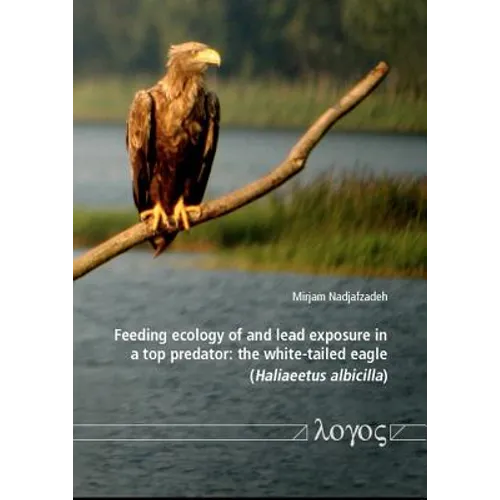
Feeding Ecology of and Lead Exposure in a Top Predator: The White-Tailed Eagle (Haliaeetus Albicilla) - Paperback
Feeding Ecology of and Lead Exposure in a Top Predator: The White-Tailed Eagle (Haliaeetus Albicilla) - Paperback
Shipping: $8.00 or FREE when you spend $100+
Couldn't load pickup availability
by Mirjam Nadjafzadeh (Author)
Although the feeding ecology of raptors has attracted the attention of many scientists, aspects such as diet selection and foraging strategy are still poorly understood. This is particularly true for large species such as the white-tailed eagle. Representative assessments of the contribution of food sources containing toxins such as lead to raptor diets are scarce but are essential for optimising conservation efforts. This dissertation investigated the feeding ecology of white-tailed eagles to shed light on the interaction of such top predators with their environment and to improve the conservation management of this lead-exposed species. A use of complementary methods identified the most effective approach for dietary investigations on free-ranging raptors. The findings revealed that the foraging strategy of white-tailed eagles is influenced by both individual and environmental factors and corresponds to an efficient food intake in terms of optimal foraging theory. The main sources of lead fragments that induce fatal lead poisoning are shot mammalian carcasses which constitute important alternative diet components for white-tailed eagles during the hunting season. One approach to solve the lead poisoning problem can be the use of lead-free bullets by hunters that fragment into sufficiently large particles which would be avoided by scavenging eagles and birds with similar feeding behaviour.
Share