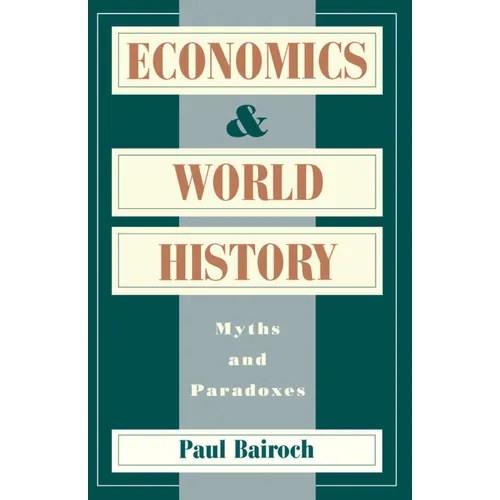
Economics and World History: Myths and Paradoxes - Paperback
Economics and World History: Myths and Paradoxes - Paperback
Shipping: $8.00 or FREE when you spend $100+
Couldn't load pickup availability
by Paul Bairoch (Author)
A bracing, no-holds-barred debunking of mistaken views of global economics
In Economics and World History, Paul Bairoch clearly and succinctly debunks a number of commonly held beliefs about economic history and the causes and consequences of important events around the world. Taking on twenty commonly held misconceptions, including that free trade and population growth have historically led to periods of economic growth; that a move away from free trade caused the Great Depression; and that colonial powers in the nineteenth and early twentieth centuries became rich through the exploitation of the Third World, Bairoch shows in each case where the mistaken belief originated and why deeper knowledge of economics shows it to b wrong. The resulting book is a treasury for free thinkers, a book that will simultaneously clear up mistakes and help readers avoid making new ones.
Back Jacket
Paul Bairoch deflates twenty commonly held myths about economic history. Among these myths are that free trade and population growth have historically led to periods of economic growth, and that colonial powers in the nineteenth and early twentieth centuries became rich through the exploitation of the Third World. Bairoch shows that these beliefs are based on insufficient knowledge and wrong interpretations of the history of economies of the United States, Europe, and the Third World, and he re-examines the facts to set the record straight. Bairoch argues that until the early 1960s, the history of international trade of the developed countries was almost entirely one of protectionism rather than a "Golden Era" of free trade, and he reveals that, in fact, past periods of economic growth in the Western World correlated strongly with protectionist policy. He also demonstrates that developed countries did not exploit the Third World for raw materials during the nineteenth and early twentieth centuries, as some economists and many politicians have held. Among the many other myths that Bairoch debunks are beliefs about whether colonization triggered the Industrial Revolution, the effects of the economic development of the West on the Third World, and beliefs about the 1929 crash and the Great Depression. Bairoch's lucid prose makes the book equally accessible to economists of every stripe, as well as to historians, political scientists, and other social scientists.
Share