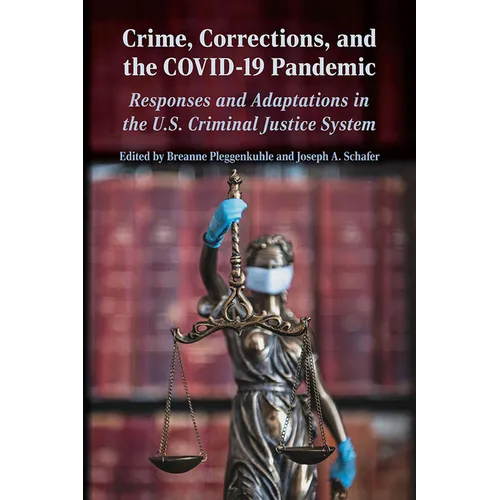
Crime, Corrections, and the Covid-19 Pandemic: Responses and Adaptations in the U.S. Criminal Justice System - Paperback
Crime, Corrections, and the Covid-19 Pandemic: Responses and Adaptations in the U.S. Criminal Justice System - Paperback
Shipping: $8.00 or FREE when you spend $100+
Couldn't load pickup availability
by Breanne Pleggenkuhle (Editor), Joseph A. Schafer (Editor), Rasheed Babatunde Ibrahim (Contribution by)
Analyses of crime and justice in an unprecedented time
While COVID-19 lockdowns affected nearly everyone worldwide, feelings of anxiety and fear were exacerbated for those already entangled in the criminal justice system. Scholars recognized the unique opportunity to study crime and the justice system's response during this period, though they soon realized that determining the pandemic's effects would be a complicated, nuanced process. Crime, Corrections, and the COVID-19 Pandemic features analyses and findings from more than thirty contributors in eleven essays. The collection examines the multifaceted social, economic, cultural, legislative, and policy responses to COVID-19 and their impacts on crime and justice. It also explores how professionals across the criminal justice system--police officers, campus police officers, attorneys, judges, correctional staff, and community supervision agents--adapted to unprecedented challenges. The book provides real-world evidence of how unconventional solutions and groundbreaking practices were implemented in response to a global crisis. Contributors analyze how incarcerated individuals, their families, and their supervisors dealt with the fear of transmission, medical care, and death. Their findings, which are necessarily dependent on timing, place, measurement, and operationalization, include both change and stasis, both negative and positive outcomes. For instance, while minor and property-related offenses initially declined, violent crimes like homicide and intimate partner violence increased. Drug usage patterns changed, leading to a rise in opioid overdoses, and despite the rise in digital interactions, there was no significant difference in self-reported cybervictimization. Furthermore, rates of gang-related crimes did not decrease. Policy and public health responses reshaped criminal activities, influencing the methods and motivations behind theft, child and elder abuse, and other offenses. This volume includes in-depth examinations of certain often-overlooked crimes, such as labor trafficking, and provides direct insights into the job challenges faced by criminal justice professionals, from probation personnel to labor rights advocates. Emerging innovations in health risk management within correctional facilities led to increased awareness and focus on specific types of crime. Responses to the pandemic revealed significant challenges, such as burnout among justice system personnel, difficulties in adapting and innovating, and challenges in providing services to vulnerable populations. Through diverse perspectives and empirical approaches ranging from advanced statistical analysis to qualitative interviews, Crime, Corrections, and the COVID-19 Pandemic offers a comprehensive exploration of the complexities that affect research results. It showcases the resilience and innovation within the criminal justice field and details the challenges professionals in this area tackled during a universally trying time, presenting valuable lessons for future crises.Author Biography
Breanne Pleggenkuhle is an associate professor of criminology and criminal justice at Southern Illinois University Carbondale. Her recent projects have primarily focused on the evaluation of the implementation, process, and outcome of the R3 (Restore, Reinvest, Renew) Illinois programs in southern Illinois. Joseph A. Schafer is a professor of criminology and criminal justice at Arizona State University. He has served as a visiting scholar in the Behavioral Science Unit of the FBI Academy, a fellow with the Australian Institute of Police Management, and a commissioner with the Commission on Accreditation for Law Enforcement Agencies.
Contributions by Rasheed Babatunde Ibrahim, Ismail Ayatullah Nasirudeen, Ben Stickle, James A. Plank, Shannon Christensen, Taylor Gerry, McKenna Bennett, Erin C. Heil, Andrea J. Nichols, David R. White, Andrew Hartung, Janne E. Gaub, Marthinus C. Koen, Jacob W. Forston, Shi Yan, Miko M. Wilford, Rachele J. DiFava, Matthew Vanden Bosch, Angela S. Murolo, Lucas Alward, Ashley Lockwood, Holly Macleod, Sarah Ackerman, Jill Viglione, Jin R. Lee, Jennifer M. Ayerza, Wei-Gin Lee, Vahid Jadidi, and Thomas J. Holt.Share