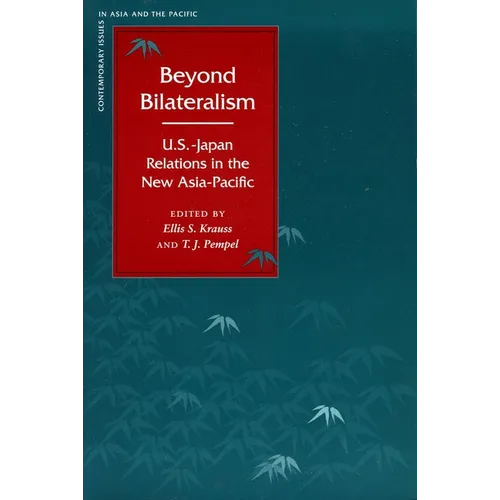
Beyond Bilateralism: U.S.-Japan Relations in the New Asia-Pacific - Paperback
Beyond Bilateralism: U.S.-Japan Relations in the New Asia-Pacific - Paperback
Shipping: $8.00 or FREE when you spend $100+
Couldn't load pickup availability
by Ellis S. Krauss (Editor), T. J. Pempel (Editor)
Beyond Bilateralism analyzes how, and to what extent, crucial global and regional security, finance, and trade transformations have altered the U.S.-Japan relationship and how that bilateral relationship has in turn influenced those global and regional trends.
Front Jacket
This is the first comprehensive analysis of the ways in which changes in the geopolitical context have altered the nature of the long-stable U.S.-Japan relationship: much of what had once been a bilateral and relatively exclusive relationship has been transformed in the past two decades. The authors present eleven case studies of important domains--ranging from increased flows of private capital to international security concerns to the growing importance of multilateral organizations--in which the relationship has been altered to a greater or lesser degree.
Individual chapters present new ways of understanding international financial flows, U.S.-Japan trade relations, and U.S.-Japan manufacturing rivalry. Others present very cogent synthetic analyses of the changing context of U.S.-Japan relations. Together they provide an account of the bilateral, regional, and global institutions--political, military, and financial--that dominate the geopolitics of U.S.-Asia relations. Although written to a consistently high intellectual level, the chapters in this timely volume are intended for a nonspecialist audience and will be useful to practitioners in business and government, as well as to students and teachers.
Back Jacket
This is the first comprehensive analysis of the ways in which changes in the geopolitical context have altered the nature of the long-stable U.S.-Japan relationship: much of what had once been a bilateral and relatively exclusive relationship has been transformed in the past two decades. The authors present eleven case studies of important domains--ranging from increased flows of private capital to international security concerns to the growing importance of multilateral organizations--in which the relationship has been altered to a greater or lesser degree.
Individual chapters present new ways of understanding international financial flows, U.S.-Japan trade relations, and U.S.-Japan manufacturing rivalry. Others present very cogent synthetic analyses of the changing context of U.S.-Japan relations. Together they provide an account of the bilateral, regional, and global institutions--political, military, and financial--that dominate the geopolitics of U.S.-Asia relations. Although written to a consistently high intellectual level, the chapters in this timely volume are intended for a nonspecialist audience and will be useful to practitioners in business and government, as well as to students and teachers.
Author Biography
Ellis S. Krauss is Professor of Japanese Politics and Policy Making at the Graduate School of International Relations and Pacific Studies, University of California, San Diego. T. J. Pempel is Director of the Institute of East Asian Studies and Il Han New Professor of Asian Studies and Professor of Political Science at the University of California, Berkeley.
Share