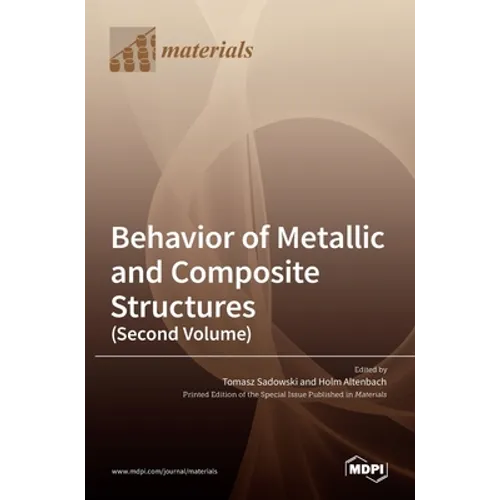
Behavior of Metallic and Composite Structures (Second Volume) - Hardcover
Behavior of Metallic and Composite Structures (Second Volume) - Hardcover
Shipping: $8.00 or FREE when you spend $100+
Couldn't load pickup availability
by Tomasz Sadowski (Guest Editor), Holm Altenbach (Guest Editor)
Various types of metallic and composite structures are used in modern engineering practice. For aerospace, car industry, and civil engineering applications, the most important are thin-walled structures made of dierent types of metallic alloys, brous composites, laminates, and multifunctional materials with a more complicated geometry of reinforcement including nanoparticles or nanobres. The current applications in modern engineering require analysis of structures of various properties, shapes, and sizes (e.g., aircra���� wings) including structural hybrid joints, subjected to dierent types of loadings, including quasi-static, dynamic, cyclic, thermal, impact, penetration, etc. The advanced metallic and composite structures should satisfy multiple structural functions during operating conditions. Structural functions include mechanical properties such as strength, stiness, damage resistance, fracture toughness, and damping. Non-structural functions include electrical and thermal conductivities, sensing, actuation, energy harvesting, self-healing capability, electromagnetic shielding, etc. The aim of this SI is to understand the basic principles of damage growth and fracture
processes in advanced metallic and composite structures that also include structural joints. Presently, it is widely recognized that important macroscopic properties, such as macroscopic stiness and strength, are governed by processes that occur at one to several scales below the level of observation. A thorough understanding of how these processes influence the reduction of stiffness and strength forms the key to the design of improved innovative structural elements and the analysis of existing ones.
Share